 Image 1 of 1
The Sacrifice (1986)
£0.00
(Offret Sacrificiatio)

Country: SV
Technical: col/bw 149m
Director: Andrei Tarkovsky
Cast: Erland Josephson, Susan Fleetwood, Valérie Mairesse, Allan Edwall, Sven Wollter
Synopsis:
The birthday celebrations of a retired actor living in privileged seclusion, and the frustrations within the party, are interrupted by news that the war to end all wars has started and they can but await their fate.
Review:
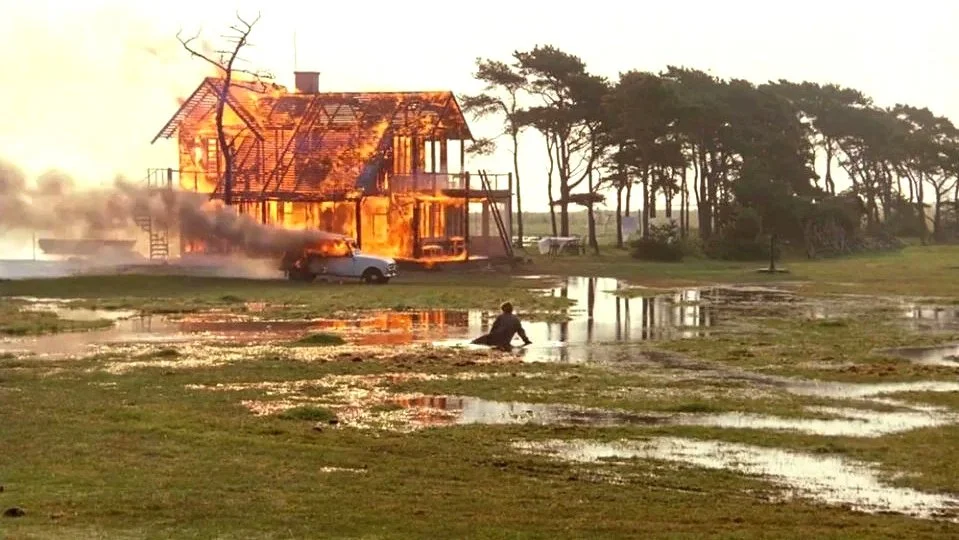
In Tarkovsky's last film, which feels like a homage to Bergman with its choice of actor, language and location, an actor who has reproached himself for spending his life talking, finally gets a chance to do something. Earlier in the film his postman, who also opines that 'a gift is always a sacrifice', has told him that it is up to him to save the world, and this too involves offering up a sacrifice. A religious film, then, and rather less agnostically so than Bergman's; instead, as often in the Russian's work, there is the feeling of a deep faith, a sacramental quality. There is also the preoccupation with the elements and symbolism to which we are accustomed. Far from a falling off, this last work is a rich and ambiguous experience. Since writing the above in 1986, my admiration for the film has grown somewhat tempered. The wilful lurches of continuity whereby Alexander seems to move without logic through the spatial realm seem to imply the deistic; other details seem merely Chekhovian (the irrelevant gun from the doctor's bag that never goes off, the general overwroughtness), or biblical (Abraham sacrificing his son Isaac, the crucificial tree topped with crown of thorns, Mother Maria and the unweeded garden): a riot of quotation going nowhere? The pace, meanwhile, even after the passage of Slow Cinema, seems truly glacial.
(Offret Sacrificiatio)
Country: SV
Technical: col/bw 149m
Director: Andrei Tarkovsky
Cast: Erland Josephson, Susan Fleetwood, Valérie Mairesse, Allan Edwall, Sven Wollter
Synopsis:
The birthday celebrations of a retired actor living in privileged seclusion, and the frustrations within the party, are interrupted by news that the war to end all wars has started and they can but await their fate.
Review:
In Tarkovsky's last film, which feels like a homage to Bergman with its choice of actor, language and location, an actor who has reproached himself for spending his life talking, finally gets a chance to do something. Earlier in the film his postman, who also opines that 'a gift is always a sacrifice', has told him that it is up to him to save the world, and this too involves offering up a sacrifice. A religious film, then, and rather less agnostically so than Bergman's; instead, as often in the Russian's work, there is the feeling of a deep faith, a sacramental quality. There is also the preoccupation with the elements and symbolism to which we are accustomed. Far from a falling off, this last work is a rich and ambiguous experience. Since writing the above in 1986, my admiration for the film has grown somewhat tempered. The wilful lurches of continuity whereby Alexander seems to move without logic through the spatial realm seem to imply the deistic; other details seem merely Chekhovian (the irrelevant gun from the doctor's bag that never goes off, the general overwroughtness), or biblical (Abraham sacrificing his son Isaac, the crucificial tree topped with crown of thorns, Mother Maria and the unweeded garden): a riot of quotation going nowhere? The pace, meanwhile, even after the passage of Slow Cinema, seems truly glacial.